Search is no longer limited to a search box and a list of blue links.
Today, a potential customer might search Google, ask ChatGPT, compare options through Perplexity, or use an AI Overview before deciding which brand to trust. GB DigitalHub describes this shift simply: buyers aren’t just searching anymore , they’re asking.
That change has brought AEO (Answer Engine Optimization) into the conversation.
But it has also created some confusion.
Does AEO mean SEO is becoming outdated? Should businesses stop focusing on rankings? Do they need a completely separate content strategy for AI search?
Not really.
The fundamentals of SEO still matter. What is changing is where and how your brand needs to be visible.
SEO Gets You Into the Search Conversation
SEO is still about making your website easier to discover and understand when someone searches for something relevant to your business.
That involves much more than keywords.
A strong SEO approach considers:
- What customers are actually searching for
- The intent behind those searches
- Website structure and technical health
- Content quality and relevance
- Internal linking and site architecture
- Authority and trust
- How organic traffic contributes to conversions
At GB DigitalHub, SEO is not treated simply as a rankings exercise.
The website highlights a Boutique Living case where the team rebuilt the search architecture and achieved Page 1 visibility in 90 days. But the work did not stop at rankings , the next phase connected SEO with conversion so organic growth could contribute more meaningfully to the business.
That distinction is important.
Ranking is a result. It is not the business objective.
AEO Changes Where the Answer Comes From
AEO focuses on a slightly different search experience.
Instead of only asking:
“Which page should appear for this search?”
answer engines increasingly need to determine:
“What is the best information to use when answering this question?”
Imagine a potential customer asking:
“Which digital growth consultant should a D2C brand consider if traffic is growing but conversions aren’t?”
They may not immediately visit ten websites and compare them manually.
An AI-powered search experience could summarise the options, explain what matters and mention brands that appear relevant to the question.
If your brand isn’t visible in those answers, you may never enter the customer’s consideration set.
That is the opportunity AEO addresses.
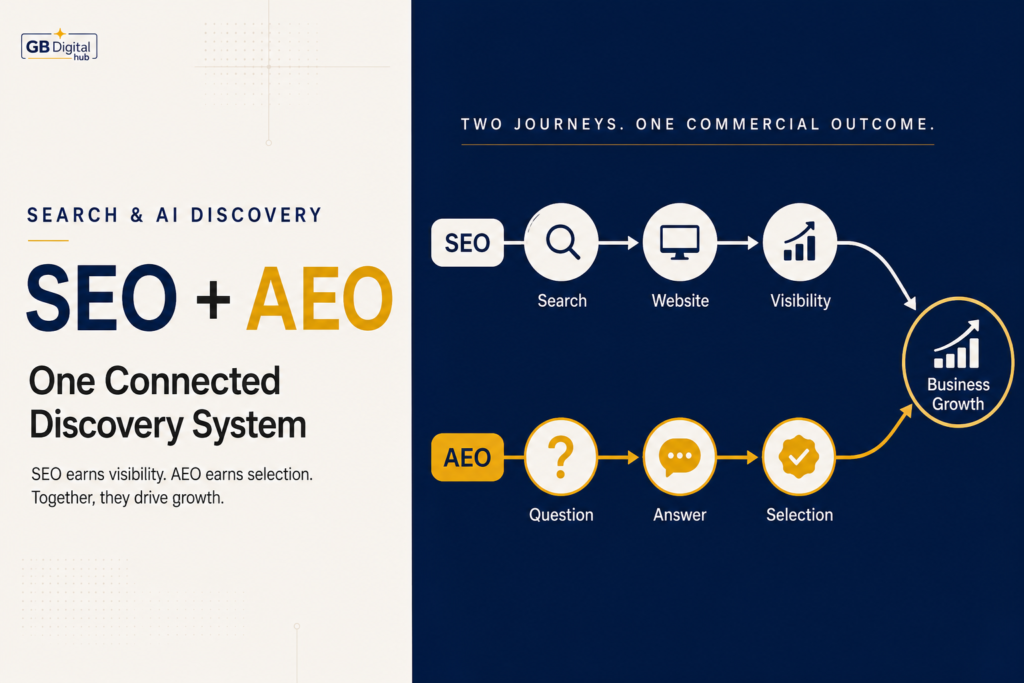
So, What’s Actually Different?
The difference is less about replacing one strategy with another and more about the type of visibility you’re building.
| SEO | AEO |
| Helps pages appear for relevant searches | Helps information become useful for direct answers |
| Strong focus on search intent and rankings | Strong focus on questions, context and answers |
| Drives users towards relevant website pages | Can influence users before they visit your website |
| Website authority and technical health matter | Website authority and clear information still matter |
| Organic traffic is a key measurement | Mentions, citations and answer visibility become additional signals |
But there is a common thread running through both:
The search system needs to understand your business and trust the information you provide.
What Hasn’t Changed?
This is where businesses should be careful.
The arrival of AI search does not mean throwing away everything that worked in SEO.
Search intent still matters
Whether a customer types a keyword into Google or asks a detailed question in ChatGPT, there is an underlying need.
A business selling premium home products, for example, should understand whether someone is researching a product, comparing alternatives, looking for advice or ready to buy.
The search may look different.
The need behind it is still there.
Useful content still matters
AEO is not about stuffing a website with hundreds of questions.
If the content is vague, repetitive or written only to attract search engines, changing the heading to a question won’t suddenly make it valuable.
The better approach is to answer genuine customer questions with specific, useful and experience-backed information
That is particularly important for businesses operating in competitive categories where generic content looks much like everyone else’s.
Technical foundations still matter
An AI-first search strategy does not make the website itself less important.
If your website is difficult to crawl, poorly structured, slow or confusing, you have a problem regardless of whether the visitor comes from Google or an AI platform.
This is why GB DigitalHub places website performance, SEO, analytics and conversion alongside AI search rather than treating them as separate activities.
What Does Change?
The biggest change is that visibility is no longer limited to your website’s position on a search results page.
Consider a typical customer journey:
Google search → AI answer → brand comparison → website visit → product/service evaluation → enquiry or purchase
Your website may only be one part of that journey.
A customer could first encounter your brand through an AI-generated answer and only visit your website later—after they already have an opinion about you.
This is why GB DigitalHub’s approach talks about showing up where buyers are searching, including Google, ChatGPT, Perplexity and Claude.
Does AEO Mean Keywords Don’t Matter Anymore?
No.
But the way businesses use keywords needs to become smarter.
Instead of creating content around one keyword at a time, think about the complete customer question.
For example, a business might target:
“digital marketing agency”
But a potential customer could actually be asking:
- Why isn’t my website converting?
- Why is my organic traffic growing but revenue isn’t?
- Should I invest more in SEO or paid media?
- Why is my brand not appearing in AI search?
- Are my marketing teams working towards the same business goal?
These are not simply keyword variations.
They represent different problems in the customer’s decision-making process.
Good SEO and AEO should help a brand address those problems.
This Is Where the Two Strategies Meet
For GB DigitalHub, this is particularly important because its approach isn’t built around managing isolated channels. The company explicitly positions its work around building the system underneath the channels bringing together SEO, paid media, content, analytics, website experience and conversion rather than allowing every team to optimise for a different metric.
That same thinking applies to AEO.
You cannot create strong AI-search visibility by simply publishing a few FAQ pages while the rest of the digital presence is unclear.
The brand needs:
Clear information + strong website foundations + relevant content + authority + consistent brand signals + measurable conversion paths.
That is where SEO and AEO become part of the same growth system.
AEO Should Not Become Another Vanity Metric
There is another trap businesses should avoid.
Just because a brand appears in an AI answer does not automatically mean it has achieved business growth.
The real question is:
What happens after the visibility?
Does the customer visit the website?
Do they engage with the brand?
Do they enquire?
Do they purchase?
Does the traffic convert?
This is where analytics and CRO become important.
GB DigitalHub’s approach starts with understanding what is actually driving traffic, conversions and revenue, and focuses on fixing conversion before simply increasing traffic.
That is a useful way to think about AEO too.
Being mentioned is not the end goal. Being considered and eventually chosen is.
What Should Businesses Do Now?
Instead of creating two completely separate strategies, businesses should strengthen the foundation they already have.
1. Understand the questions customers actually ask
Go beyond keyword volume. Look at the problems, comparisons and decisions behind the searches.
2. Build content around those problems
Create resources that genuinely explain, compare and solve not just content designed to fill a publishing calendar.
3. Make the website easy to understand
Your services, products, expertise, proof and important information should be clear to both users and search systems.
4. Connect SEO with conversion
More organic visibility is useful only when the experience that follows helps people take the next step.
5. Start measuring visibility differently
Rankings and organic traffic still matter. But businesses should increasingly pay attention to how they appear across AI-driven search experiences and whether that visibility contributes to meaningful business outcomes.
The Real Shift Isn’t SEO to AEO
It is a search to discovery.
Customers now have more ways to discover information than ever before.
They search.
They ask.
They compare.
They validate.
And only then do they decide. For a business, this means being visible at just one point in that journey may not be enough.
The stronger approach is to build a digital presence that canbe discovered, understood, trusted and acted upon across those different moments. That is also why treating SEO, AEO, analytics and CRO as completely separate projects can create the same problem GB DigitalHub sees across businesses: every team may be doing its job, while nobody is responsible for the complete growth outcome.
Final Thoughts
AEO is not here to replace SEO.
SEO still provides the foundation: strong technical health, relevant content, search intent, authority and a website that works.
AEO extends that foundation into a search environment where customers increasingly expect answers, comparisons and recommendations not just links.
For businesses, the question should therefore not be:
“Should we choose SEO or AEO?”
It should be:
“Are we visible wherever our customers are making their decisions?”
Because the future of search isn’t simply about ranking first.
It’s about being part of the answer—and making sure that answer leads back to a digital experience that actually converts.